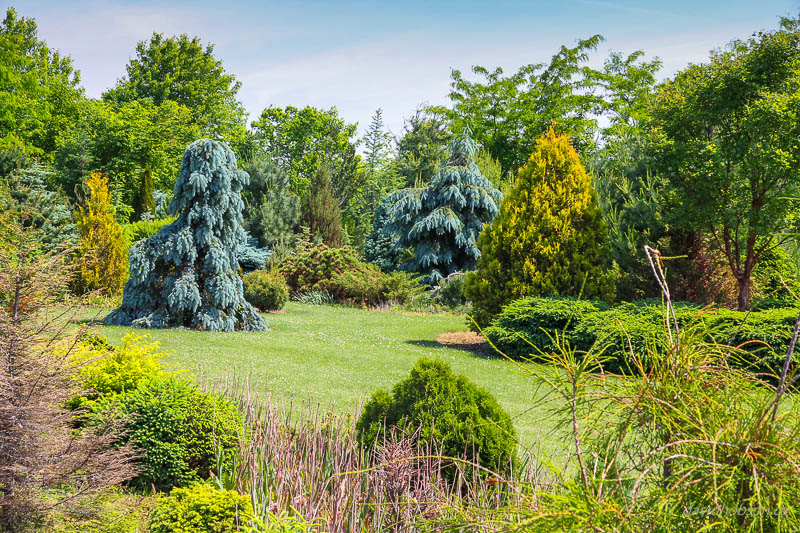
Arizona Desert Botanical Garden


The plan was to escape the snow for once, except this was the winter without any. Regardless, it didn’t discourage me from taking a trip south in February to do a little hiking around the red rock country in Arizona. Even there at higher elevations we walked in snow, but in Sedona apple blossoms were blooming. And down in Phoenix spring was well underway, a perfect time to explore the Desert Botanical Garden under a dazzling blue sky. I couldn’t possibly miss the opportunity to see this extraordinary garden filled with rare and unique plants of the Sonoran desert that covers much of the South West United States and parts of Mexico.


The Desert Botanical Garden was first conceived by local people back in the nineteen thirties who saw the need to preserve their native flora. The garden has grown to 58 hectares with more than 26 under cultivation containing fifty thousand plants: yuccas with flowers on four meter stalks; huge, spiky agaves; desert wildflowers; and of course, cacti in all shapes and sizes, including a bonus — at the main entrance stands a group of priceless ones created in glass by renowned sculptor, Dale Chilhuly.

Volunteers started the garden and it is volunteers who keep it humming along, all eleven hundred of them. I met a number stationed along the trails as interpreters, happy to talk to visitors about the plants in their care. One section named the Plants and People of the Sonoran Desert contains the plants that were used to house, clothe and sustain the desert dwellers of the past. Another is reserved as an outdoor classroom where cottonwood trees shade groups of schoolchildren who gather to study the plants and, with luck, grow up to be tree huggers, except hugging is not a good idea in this garden.

Getting around is easy on wide, paved trails — essential, as wandering off piste is neither permitted nor advisable where the majority of plants are assertive cacti, especially the huge, ubiquitous saguaro. This is the cactus of countless old westerns, the original cartoon cactus, growing as tall as fifteen meters with multiple arms reaching for the sky. Sue, one of the volunteers, was on hand to explain how the arms sprout forth to increase production of the night blooming flowers that appear in April. These are followed by ruby-coloured, edible fruit in June.
 
I also learned that when birds nest in holes pecked into the side of the Saguaro, the plant then cooperates by forming a smooth callus to line the hole, making a perfect nesting box. What did surprise me was the sight of a dead Saguaro. Somehow I thought it would simply turn mushy and rot away, but not so. Instead, it resembled a bundle of split cedar rails.

The trees and shrubs of the Sonoran are designed to retain water and reduce transpiration from their leaves. The cottonwood tree there has two sets of roots — one close to the surface that spread beyond the drip line and another that drives deep into the earth to reach the water table. The creosote shrub (Larrea tridentata) is another plant with a strong will to survive harsh conditions. It has no connection with the common wood preservative, but it does have many uses, particularly medicinal, though like many herbs, dangerous if used unwisely.

It really isn’t a friendly bush. To conserve moisture, it inhibits the growth of other plants in the area, while its small, resinous leaves wouldn’t spare a hint of moisture for the thirstiest coyote. When it does rain, however, the leaves fill the air with a pungent odour, considered unpleasant by some. Volunteer Janet showed me how to sample the fragrance by simply breathing on the leaves then taking a sniff — conclusion: more a deodoriser than a designer air freshener.

As usual, there were too many plants and too little time, but I thoroughly enjoyed my visit and highly recommend it for anyone passing through the Phoenix area, and it almost never snows in the Desert Botanical Garden.

Alnwick Castle


In northeast England, there’s an interesting new garden. New that is, compared to most UK gardens on the tourist route there. Gardens dating back to Victorian times are the norm, others centuries older. This one, however, only opened its gate to visitors ten years ago, which made me almost first in line, relatively speaking, when I stopped by this fall to check it out.

The garden is located in the picturesque market town of Alnwick (pronounced Anick) in Northumberland. Alnwick is a busy little place, described as one of the best places to live in Britain. Just a half hour drive from the Scottish border, it’s been around for about fourteen hundred years.

The town is dominated by Alnwick castle, home since the eleventh century to a long line of powerful northern barons. Situated on the Great North Road that leads from London to Edinburgh, it was built as a first line of defence against the Scots. 


Today, the castle is home to the current Duchess of Northumberland, a serious gardener who, instead of deterring visitors, decided the castle needed a little something extra to attract even more. And so was created Alnwick gardens, designed by Jacques and Peter Wirtz, from Belgium. Up against stiff competition from other, much frequented, British gardens, Alnwick needed to be unique, and I’d say they achieved it. At most popular attractions these days, it’s a case of exit via gift shop, but at Alnwick I entered that way — kind of.

The access to the garden is through a visitor center that was designed with people in mind. Resembling a huge conservatory, it offers all the usual facilities and is large enough to accommodate a good number should fine weather not coincide with a day’s visit. In fact, the restaurant and the terrace outside offer the first view of the gardens, an impressive vista of The Grand Cascade, a massive stone water feature that flows toward the viewer down a gentle sloped bank beyond acres of lawn.

Reminiscent of the fountains of Versailles, and the largest of its kind, it is state of the art, with computers controlling a flow of thirty thousand litres of water a minute. It can be viewed from afar or close-up from windows cut into the walls of the tunnel-like hornbeam pergolas that flank the sides and echo the curves of the stone work. Above are more fountains, pools, rills, and a place to view the cascade where it begins its flow.

The Grand Cascade makes Alnwick garden unique, but there’s more. It is a working garden, too. On a small plateau at the head of the property is a walled garden growing every imaginable fruit and veg possible. It was here I discovered Strulch, finely textured mulch manufactured from wheat straw that the gardener I spoke to was happy to rave about, particularly as it appeared to provide an effective defence against slugs and snails.

From the walled garden, I spent a while lost in the requisite maze, but not just any old maze of cedar or yew hedges, but one of tightly grown bamboo. I did make my way out eventually, but the manner in which the bamboo swirled around the circuitous pathways, letting in just enough light from above, was mildly confusing; in the dark it could be panic inducing. I’m thinking that the Duchess of Northumberland would have been a formidable foe in times of battle. No surprise, then, that she also has a famous poison garden, too. 

It’s located behind sturdy wrought iron gates emblazoned with skull and crossbones and a sign that says These Plants Can Kill. I joined the tour led by an enthusiastic guide with a gift for relating gruesome tales of the uses to which the plants have been put — appropriately close enough to Halloween.

I concluded my visit whilst it was still daylight — too many ghosts of countless battles fought here, but a lovely garden to visit.

Garden Walk Buffalo


There are three major reasons that local people travel to Buffalo: Sabres games, airport, or cross border shopping. I just discovered an even bigger reason to make the trip — Garden Walk Buffalo with 350 open gardens.

Last weekend, with a couple of other garden writers, I was invited to a preview of the gardens and was amazed at the enthusiasm and commitment to gardening in a community that is successfully shedding its image as a tired industrial city. There is now a beautiful, accessible waterfront right downtown, an amazing architectural heritage just waiting to be discovered, and in July, the wonderful Garden Walk Buffalo takes place, and it is all free.

The idea for the garden walk began with a small neighbourhood association in 1993 and has grown to be the largest event in the US. It’s non-profit, run by volunteers. Any money raised by way of donations or sponsors is reinvested in gardens. A current project is a street for front yard makeovers. We visited Newman Place in South Buffalo where nine local landscape companies donated time and material to transform the properties of thirteen lucky homeowners who have been transformed into proud, happy gardeners. 

Gardeners are typically friendly and welcoming, and each one has a story. On the garden Walk we met Ellie Doherty on Summer Street who is known as the guerrilla gardener in her neighbourhood. Not content with cramming her tiny backyard full of plants, she’ll also fill any empty space in her neighbour’s gardens. On quiet, shady Lancaster Street, with its brightly coloured, Dutch colonial homes, it seemed every one had been visited by Ellie, not denying it has its own share of enthusiasts.

At number 75 is Mary’s garden. Not big enough for Mary and her husband James, they demolished the house they owned on the next door property and filled the space with clematis, mandevilla, hydrangeas and wisteria. Sadly, Mary died soon after the garden was completed, but her name and garden lives on.

At a large Victorian house at 755 West Delavan Avenue, lives Jennifer Guercio where with her husband she embraces the era by donning Victorian dress to welcome visitors to her place. Unlike Queen Victoria, she is amused, and amusing when she tells us how she carries the huge koi from her pond in her arms down to a basement greenhouse for the winter. With the largest almost half a meter long, that is a committed gardener. Did I mention the garden — even more commitment, and truly Victorian.

We saw many lovely gardens on our short tour, but there was one more highlight, the Buffalo and Erie County Botanical garden. This alone is worth the drive to Buffalo. Influential landscape architect, Fredrick Law Olmsted, designer of central park in New York, also designed Buffalo’s impressive park system that threads throughout the city, and part of his vision was the Botanical Gardens.

In the garden there is a marvellous, three domed, Victorian conservatory. Built in 1897, it was modelled on the Crystal Palace and the Palm House in Kew gardens in London. Having visited Kew, I felt Buffalo has a worthy rival that is in fact larger, with an area of one acre housing 20,000 plants, including 300 species of ivy. And it’s certainly easier to get to.

So, see the hockey game, use the airport, and shop, but do take time out to explore the new and old Buffalo, and see hundreds of lovely gardens. Learn more at http://www.gardenwalkbuffalo.com/

 First published July 2011 Waterloo Region Record and Guelph Mercury 

Thailand Tripping


I froze at the sight of the weapon pointed directly at me. It was in the hands of the ten-year-old with a gleam in her eye. She let me have it. I shrieked; she shrieked, then we both burst into laughter. It was only a water gun, a massive water gun, as big as her and fully charged. And she kept her hand on the trigger.

I was at the Songkran festival in Chiang Mei, Thailand. I should have known something was afoot when I passed through arrivals at Bangkok airport and saw travellers with water guns strapped to their bags and backpacks. Yes, people actually do fly to Thailand to participate in the Songkran festival, or at least in the world’s biggest water fight.

Before I traveled to Chiang Mei and my soaking, I first spent a few days in Bangkok experiencing a city of around ten million people that manages to absorb and sustain ten million visitors a year. Only London, England welcomes more, but Bangkok, with its reputation for the exotic intact, offers a unique experience.

First morning in the city I hopped into a tuktuk, the ubiquitous three-wheeled cab powered by a motorcycle engine and a driver who cheerfully took on the challenge of beating the regular cabs to their destination. Tuktuks are artistically and/or garishly decorated, and when tossed into the mix with orange buses and a fleet of cabs painted either flamingo pink or banana yellow, I felt as though I was riding on the assembly line at a Smarties factory.

When my tuktuk balked at a narrow gap between a tanker truck and a bus, the space was taken by a pair of motorcycles, a family of three riding on one of them. Daredevil riders from a circus, on their day off, I thought to myself, except there were hundreds of them in the traffic stream, muscling out other vehicles for the pole position at stop lights. Many motorcycles operate as one passenger taxis, mainly used by local Thai people for fast, inexpensive transportation. Young women ride side-saddle, sitting demurely, with one hand on the seat handle. My driver informed me that wrapping their arms around the front rider, a stranger, would be flouting social convention. Nerves of steel indeed.

Thailand has a unique culture, due partly to it never having been colonised by Europeans. Seventy percent of the population is Buddist and has a non-confrontational approach to life, which must no doubt account for the noticeable, and welcome, lack of honking from cars.

I arrived safely at my destination, the Jim Thompson House and museum, which is set in a peaceful tropical garden filled with glorious orchids, which are almost as ubiquitous as dandelions in Thailand.  Here I learned the story of Thomson, the American ex-serviceman credited with revitalising the hand-made silk industry in Thailand.

In 1948 Thomson, with a partner, formed the Thai Silk Company. After Yul Brynner appeared on movie screens around the world in The King and I, with the cast in Thai silk, success was assured. No more army fatigues for Thomson. He built himself an elaborate house using traditional Thai buildings which he had dismantled and transported from elsewhere in the country. He then filled the gorgeous teak buildings with his collection of antiques and rare works of art, clearly enjoying his success.

It came to an end in 1967, however, when during a visit to the Cameron Highlands in Malaysia, Thomson mysteriously disappeared, never to be seen again. The legend lives on in the museum; one of Bangkok’s appealing attractions, a charming oasis in the city and a source for genuine Thai silk. After learning the legend I felt I couldn’t possibly leave without at least a silk handkerchief — okay, it was a silk shawl and it hit the souvenir jackpot on my return.

After the quiet serenity of the museum I visited The Royal Grand Palace, the most popular tourist destination in Bangkok. Just getting past the souvenir sellers and street food vendors outside the walled compound was enough of a challenge, but then tantalizing street food alone is another major attraction of the city. I snacked — the fresh coconut with a straw was too hard to resist.

Even the souvenir stuff, which I can normally resist, caught my attention. When Noel Coward wrote “only mad dogs and Englishmen go out in the midday sun,” he was hardly being fair, as tourists of every nationality were clamouring for fans and sun hats.

Inside, the 60 acres can easily accommodate thousands of visitors, leaving all of them, me included, awestruck at the sight of the unbelievable structures. The first King Rama began construction of the amazing complex in 1782 when he chose to build a new palace. Subsequent rulers didn’t hold back, adding over a hundred halls, residences and government buildings, each more ornate than the last. Although the King of Thailand (a constitutional monarchy) no longer lives full time at the Royal Palace, it is still used for many state functions, ceremonies and royal rituals, and is the spiritual center of the Thai kingdom.

Beside giant statues of mythological demons, families were posing for group shots, while I was trying hard to avoid having Uncle Alfred and the kids cluttering my images. Fortunately, the buildings tower over mere mortals and when gazing upwards to the mosaic walls, red tiled roofs, and gilt covered towers shimmering in the sun, I settled into a sense of wonder at it all.

The wonders continued. One of the buildings, Wat Phra Kaew, is the Temple of the Emerald Buddha, the most sacred Buddhist temple in Thailand, and a large crowd was intent on seeing it. Since I couldn’t miss the opportunity to see something so important, I followed one of the groups and found myself at the entrance where each person was taking a turn to bless their companions by dipping a lotus flower into a large, bronze bowl of holy water then shaking it gently over their heads. I was blessed, too, a sign of things to come, then I returned the favour, unsure whether I was suitably qualified.

Before entering the temple, custom requires that footwear must be removed and I added mine to the pile. Inside, despite the mix of day trippers, devoted followers of Buddha, and security people cautioning anyone holding a camera about taking pictures, I could feel the serenity of a holy place. I took a moment and prayed, mostly that I would find my shoes again on the way out.

I left the opulence of the past and returned to the bustle of the city and of the present. Bangkok is renowned for its shopping and the Siam Paragon entertainment and shopping center exemplifies this. I slipped inside, partly to enjoy a little air conditioning, and found myself exploring six storeys of reasons why it is described as the Pride of Bangkok. All the renowned boutiques of the world are represented, and on the second floor, for those who desire a more refined mode of transport than the humble tuktuk, I discovered a showroom filled with Aston Martins, Bentleys and even Lamborghinis.

I couldn’t leave without making a purchase, and feeling relatively poor and obscure beside the car showroom, I picked up a magazine and left the rest for the rich and famous. I also passed up MacDonald’s on the ground floor where Ronald stood, his palms pressed together prayer-like, as in the Wei, the traditional Thai greeting. I opted instead for genuine Thai food on the street.

It’s impossible to avoid the amazing range of street food as friendly vendors line the sidewalks. They cook up everything that can possibly be cooked, turn it into a tantalizing gourmet meal — a little red chicken curry (panang gai) here, a little pad Thai there, and an endless supply of fresh fruit, all served with a ready smile that isn’t taught in a corporate training program. It can be a gamble, though, unless you’re a knowledgeable fan of Thai food. The level of sweet, sour, spicy, or deadly hot isn’t always conveyed as clearly as this tentative taster would prefer. My advice is to watch the line-ups and gauge the reactions.

My brief stay in Bangkok over, I took a one hour flight north to the historic walled city of Chiang Mei, the cultural heart of Thailand. It’s here that I encountered the Songkran festival in full swing. Songkran falls in mid April during the hottest time of the year and marks the start of the Thai New Year. It’s celebrated with as much intensity as our New Year, except it lasts for a week in Chiang Mei. There’s a daily parade, but not really a parade in the sense of standing and watching it pass by. Attend and you’re part of the parade, like it or not.

The festival originated with the blessing and ceremonial washing of statues of The Buddha, the water then captured and poured gently over the head or shoulders of the young and the hands of elders to bring good fortune. In addition to the water blessing, an even older tradition involves the smearing of a white paste on faces as a sign of protection, warding off evil spirits. It is to be left on until it eventually washes off of its own accord.

Before attending the parade, I took time to visit one of the many temples and watched dignitaries make speeches as a huge statue of Buddah was removed with great care from the temple in preparation for its place in the parade where it would be ritually bathed. It was a joyful atmosphere with flags and flowers, young men pounding taphons — the traditional Thai drum, young women performing elegant dances, more enticing food, and flowers in the form of garlands, worn by almost everyone present.

Within the temple grounds there was little water splashing. On the street, however, the festival of the past has evolved into the world’s biggest water fight. And yet it’s unfair to describe it as a fight when everyone is howling with laughter, the concept of non-confrontation joyfully set aside. As the parade passes by, participants and watchers merge in one glorious deluge of water, squirted, pailed, splashed, and hosed, ensuring all present are thoroughly soaked. The only limitations are no splashing of neighbouring stores and no splashing indoors. It’s relatively safe to venture out after the sun has gone down, but set foot outdoors anywhere in daytime and some wily child with pail and a water source will drench you, whether you’re walking, riding a bike, or riding in a tuktuk.

The only advice is to buy a pail and join in — after carefully storing passports and wallets in plastic bags — double bagged. I took a risk using a camera to capture the festival, but by tuning up my spidey sense and carrying a large plastic bag, I managed to avoid direct hits. My first real encounter occurred when I found myself in a high noon situation squared off against the ten-year-old — she had the monster water gun and I only had my camera. I got the camera into the bag okay, but she gleefully blessed me thoroughly. From then on it was a squishy and squelchy, but hilarious afternoon.

Amazing Thailand — truly amazing.

First published June 2011 Waterloo Region Record and Guelph Mercury 

Monet's Giverny

It was a single red poppy in a field of wheat beside a busy parking lot that caught my attention. The solitary flower had a calming affect on me after having just spent too short a time whirling through Claude Monet’s garden. It’s a busy place, visited as it is each year by half a million art lovers and gardeners from around the world. 

Those are the two main reasons to visit — to see what inspired his art or the garden that Monet created — or both. In reality, it is hard to separate the two.  I suppose I approached it as a gardener, but as soon as I stepped into the garden, it became less about plants and more about the images before me. I felt I was strolling through a living gallery of Monet’s art.

The sight of the oh so familiar water lily pond, however, featured so often in his paintings, managed to evoke a little gardener envy. The strolling pathway meanders around it, bordered by weeping willows, Japanese maples, bamboo and irises, allowing for a constantly changing perspective of the famous lilies. I crossed over one of the most painted and photographed bridges in the world beneath a huge blanket of wisteria. When in bloom a week or two earlier, the fragrance would have been heavenly.

I skipped taking my own picture of the bridge, crowded as it was with pond viewers and left to enter the main garden. The two areas are separate, each a couple of acres in size divided by a busy road. Monet began developing the gardens after moving there in 1883, then ten years later bought the land across the road where he had the pond dug. He would only have had to dodge the occasional horse and cart, but distracted visitors can now cross safely by way of a tunnel.

The garden is described as a Clos Normand, enclosed by walls and planted much as an English cottage garden filled with annuals and perennials and roses. Oh the roses — huge and healthy, masses of them all in bloom growing over arbors and walls, competing with clematis, fighting for space on the ivy covered house and filling flower beds.

The beds are simple and not for the neatnik. They’re long and narrow and don’t meet any concept of current landscape design. They stretch down the gentle slope from the house, each one a slightly different palette from its neighbours, filled with endless clumps of plants chosen to contrast or complement in colour, texture, shape and size. It’s peak time for poppies, purple and mauve against a perfect shroud of Verbena bonariensis, just one example of Monet’s artistic skill. Monet sure knew his colours.

Due to the number of visitors the narrow inner walkways between the beds are cordoned off, which is wise. Fill them with people and it would look like a checkout line at a garden center, and it would increase maintenance work for the gardeners, all eight of them.

The head gardener is now British born James Priest who only started his job on June 1st, a couple of days after I visited the garden. He’s a 53-year-old Kew trained horticulturalist from Liverpool, but he has lived in France for 27 years. Priest has stated his intent is to ensure Monet’s concept is fully realized with a review of the original garden. 

After Monet died in 1926, the garden deteriorated and was eventually abandoned, the flower beds covered in turf and the pond soon filled with silt.  Restoration only began in the late 1970s by Gerald van der Kamp, curator of the property with head Gilbert Vahe. His retirement after 35 years tending the garden opened up an opportunity for James Priest to take over.

After only an hour or two there, I had to leave too, to return to my own garden where there are a couple of poppies waiting to bloom.

First published June 2011 Waterloo Region Record and Guelph Mercury  

Nong Nooch Tropical Garden, Pattaya, Thailand

It may seem like a long way to go to look at plants, but with only a few adventurous crocuses attempting to lead reluctant participants in a spring parade, the Nong Nooch Tropical Garden near Pattaya, Thailand was a welcome break earlier this month. And there I was, a dazed look on my face and my mind completely boggled as I tried to comprehend one of the world’s most amazing botanical gardens. The effect wasn’t due to jet lag — with a glass or so of wine, a few in-flight movies and a decent sleep, the flight was merely time consuming.

I should have had a clue to what was awaiting me at Nong Nooch after seeing their gold medal winning display at last year’s Chelsea Flower Show, but I was unprepared for 600 magnificent acres of lush tropical gardens — and elephants. The Nong Nooch Tropical Garden was only part of a Thailand tour, with precious little time to explore, but I made the most of it by hopping on the shuttle that meanders through the gardens. It’s the most convenient option for seeing the park, and most of it can be covered in half a day, but ideally an extended stay at accommodation within the park is the way to go.

Nong Nooch is a private garden that was to have been a fruit plantation when the land was first purchased back in the fifties, but after Mrs. Nongnooch Tansacha became inspired following visits to world renowned gardens, she decided her land would be perfect for a botanical garden of her own. It opened to the public in 1980 and has deservedly become a wildly popular tourist attraction, now under the management of her son, Mr. Kampon Tansacha.

The secret of the garden’s success is its ability to offer something for everyone, but for the solely botanically minded, one of the largest selection of orchids in the country and more types of palms than I ever knew existed are there for viewing. An encyclopaedic collection of tropical plants that struggle to bloom in our living rooms and on our window sills lay before me, embraced by the fragrance of frangipani in full bloom. And for the landscape designer, an immaculate garden in the style of Versailles that had me digging around in my camera bag for another memory card.

Then it was on to what our guide called Stonehenge. Perhaps it didn’t exactly replicate the original, but it was certainly impressive, and he made a point of proudly informing his passengers that while the one in Britain has been a puzzle for eons, he knew precisely when and who built this one. And besides, compared to the bleak Salisbury plain, what ancient druid wouldn’t have preferred this lush tropical setting.

I saw as much of the sprawling gardens as possible in the time allotted — a hillside dotted with temple replicas, a huge man-made lake surrounded by wafting palms, dragon sculptures, lotus flowers and water lilies, topiary tigers, and what I can only describe as the ultimate in garden art. I love terra cotta pots — even have a group cascading down my fence, and I’ve been amused and impressed by cleverly contrived flowerpot men at many a garden show, but the sight of a towering wall, sweeping arches, and a menagerie of animals, including rearing elephants, all composed entirely of plant pots had me thinking I should free up some space for at least one moose. I duly noted that a moose was not part of the Nong Nooch display.

This was a botanical garden unlike any other in the world and a head shaking wonder that I’d have loved to spend days in, but there was yet more to see in amazing Thailand, and after feeding bananas to the real elephants, it was time to move on, earnest crocuses long forgotten.


First published April 2011 Waterloo Region Record and Guelph Mercury   

Kota Kinabalu, Malaysian Borneo

I lost my hat in the South China Sea. It wasn’t the gentle, cooling breeze tempering the hot midday sun that whipped it away. It was the speed of the power boat I was riding in as it shuttled passengers between Kota Kinabalu, capital of Sabah state in East Malaysia and Sapi Island

Just a speedy ten minute boat ride offshore, the island is one of a group in the marine park named after Malaysia's first Prime Minister, Tunku Abdul Rahman. Visitors are drawn to the Sapi’s white sandy beaches, swaying palm trees, and tropical rainforest, where huge monitor lizards can be seen lazing about at the forest edge. They wait patiently for visitors to leave, but curious macaque monkeys, with the same attitude as raccoons, will occasional leave the forest to see what’s for lunch.

Terrestrial wildlife aside, the park is one of the finest locations anywhere for scuba diving, but for the non diver, Sapi offers a unique experience — under water walking. The only requirements are the ability to walk and breathe — easy. I tried it and didn’t even get my hair wet. Wannabe Captain Nemos descend just a few meters to the sea floor wearing a weighted helmet that’s supplied with a steady flow of clean, filtered air. Groups are chaperoned by an experienced scuba diver, plus the area is cordoned off for safety. 

There was no need to walk far, however, as schools of curious, exotically coloured fish immediately show up to greet an alien invasion of their world. The experience was a delight, like being inside the aquarium for a change. It is one of many unique attractions awaiting the tourist willing to travel to the outer limits of a well traveled planet.

On the return trip from Sapi, the boat docked at Jesselton point. Jesselton is the former name of Kota Kinabalu, or KK as it is known. It was named after Sir Charles Jessel, a Vice Chairman of the British North Borneo Company at a time when Malaysia was under colonial rule. During World War II, Jesselton was abandoned then bombed by the retreating British to prevent it falling into enemy hands. After the war, the city was rebuilt by the new colonial government and, in 1968, eleven years after independence of Malaysia, it was renamed Kota Kinabalu.

During colonial times, Jesselton attracted adventurers, northern land pirates, and Foreign Service diplomats. One of those diplomats was Francis George Atkinson, the first District Officer during the British North Borneo Chartered Company Administration. He died of malaria in 1902 at the age of 28. As a memoriam, his mother, Mary Edith Atkinson, had a clock tower erected on the highest hill in the city, Signal Hill, at that time known as Bukit Brace. The tower, used as a navigating aid for years is one of only three buildings to survive the wartime bombing. Also on Signal Hill is an observatory with platforms that offer amazing views of the city, the South China Sea, and the outlying islands, shorelines clustered with water villages.

To capture and preserve the history and culture of Borneo, the state of Sabah, in 1985, created an impressive complex containing a museum, botanical and zoological gardens, and a heritage village that shouldn’t be missed. The main museum building, inspired by the longhouses of the indigenous people of Borneo, contains a rich display of artefacts including, of course, a nice assortment of skulls. This was the home of head hunters in a bygone age. At least it was only my hat that I lost.

Now, with a population of half a million, and a popular gateway for travellers visiting Borneo, Kota Kinabalu is the fastest growing city in Malaysia. The increasing popularity among tourists hasn’t yet jaded its citizens, who are warm, friendly, and polite. To shop leisurely in the huge, waterfront handicraft market or in the main street market (where inexpensive pearls are a featured item) without being subjected to the slightest sales pressure is a rare pleasure for the traveller.

The city, and Malaysia as a whole, has made huge strides in development in the relatively short time since independence. Construction may have produced a modern infrastructure including luxury hotels and modern, international airports, but tradition is respected. This is evident in the state mosque, a stunning building close to the centre of the city. It combines Islamic architecture with a contemporary design, and while the towers and majestic dome inlaid with gold motifs gleam in the sun, the interior of the building offers a respite from the heat of the day. Other than Fridays, which is a day of prayer for Muslims, visitors are welcome providing they follow the dress code — no shorts and covered heads for women. Equally impressive is the Kota Kinabalu City Mosque at Likas Bay. Like a desert mirage, it soars out of a manmade lagoon alongside the coastal highway on the outskirts of the city.

Mosques appear throughout Malaysiais  Islam is the official religion — and they have an imposing presence in the same way as western churches and cathedrals do, but on the street, in the market, the atmosphere is pleasantly relaxed. 

Communication isn’t a problem. Although Malay, also known as Bahasa, is the official language, everyone seems to speak a little English, a useful remnant of the British Empire, while "Manglish" a mutation of the two languages mixed with local dialects is commonly used too. But, with echoes of Quebec, there are government plans to reduce the use of the local lingua franca while promoting correctly spoken Malaysian.

Whatever the language; shopping, eating, and getting directions there is simple — ask anyone where to find food and you’ll get a favourable response. Food is revered and relished in Malaysia, and with numerous ethnic groups plus sizable Indian and Chinese populations, there’s a huge range of deliciously varied and often integrated styles of cooking. The less adventurous gourmand will be happy to learn there is a solitary representative of the western fast food industry present downtown — a KFC store — open 24 hours.

Meanwhile, local restaurants serve up local game and endless varieties of chin dribbling fresh fruit, the stuff we’d pay a fortune for in our grocery stores — sweet and sour rambutan, much sweeter pulasan, which is rare outside south-east Asia, and the infamous durian, both revered and abhorred due to its unique fragrance. The strange odour even permeates the husk and has caused durian to be banned in many hotels and public places, and yet the fruit is delicious.

There’s abundant fresh sea food, with shellfish in particular prepared as take out food from street vendors to be eaten with fresh cili padi (small chillies) and a lime dipping sauce. For those who like to catch their own fish, the South China Sea around Kota Kinabalu and Sabah offers excellent sport fishing opportunities.

Away from the sea, inland, are the rainforest mountains that rise to east of the city, only a couple of hours drive away. Dominating the skyline and giving the city its name is Mount Kinabalu. At 4,095 metres, the frequently cloud shrouded mountain is the highest in the Malaysian archipelago. The origin of the name is uncertain, possibly meaning a Chinese Widow or the revered place of the dead, but what is known for certain is the uniqueness of the mountain.

Its slopes and foothills hold an amazing number of plant species, including some of the rarest of orchids. The incredible biodiversity is due to the dramatic changes in climatic conditions that range from sea level through tropical to near freezing at the summit of the mountain.

Wisely, in 1964, the government created the Kinabalu National Park, since designated as a World Heritage Site and one of the most important biological places in the world. It now attracts half a million visitors each year who arrive to see the unique species of plants, to try to spot the 326 species of birds found there, or simply to climb the mountain.

It doesn’t require mountaineering skills to conquer Kinabalu, but climbers are required to be accompanied by guides. A fit, well prepared person is expected to take less than two days to hike, clamber and crawl to the top. The average rainfall in the park is 2700 mm a year, enough to swim in, so it’s best to avoid the rainiest seasons. Attempts are best made during the driest period, from January to April, but note driest doesn’t mean rain free.

Naturally, there are competitive types who want to race to the top and their needs are provided for. Super fit athletes can challenge the mountain in one of the toughest mountain races in the world. The Mount Kinabalu International Climbathon was established in 1987 and takes place each October. It attracts a highly competitive, international field that must run a total distance of twenty-one kilometres up and down the mountain. 


This is a gruelling race that was initially restricted to Malaysians, but was soon opened to international participants and now attracts the best mountain runners in the world. The best manage it in less than three hours. I’ll wait for the helicopter franchise to start up; meanwhile the bus ride back down the mountains to the city provided enough adventure. I held on to my new hat.

Published October 17 2009 Waterloo Region Record and Guelph Mercury

Royal Horticultural Society at Wisley, UK

Over ten thousand varieties of plants for sale in the plant center, said the sign. Now, I’d normally be in there scooping everything in sight, but this wasn’t any old garden centre and there wouldn’t have been much point buying plants. This was England and, sadly, smuggling rare plant material home to Canada is serious business and I wasn’t prepared to risk it. Telling a customs officer that the green stuff in your sandwich really is lettuce is one way to import a cutting, but be prepared to eat it or face a really big fine. It did cross my mind, especially when faced with some of the rarest plants in captivity.

I was at Wisley, the principle garden of the Royal Horticultural Society, same folks who put on the Chelsea Flower Show. Our group had spent a day at the Chelsea show and been as overwhelmed and amazed as ever, but now we were enjoying a more relaxing pace viewing the plants and gardens at Wisley, a world-class garden and a botanist’s dream.

This is where many of the plants that end up in your garden originate. For over a hundred years, this former estate covering twenty-four hectares has cultivated and carried out countless trials of new fruits, vegetables and flowers. Different cultivation techniques are tested, and composting is studied at the PhD level — okay, they take it very seriously. Besides being an ornamental garden, Wisley is a centre for education and research.

I didn’t actually enter the plant centre — no point. We were surrounded by flower beds and woodlands containing even more varieties and unusual specimens. Azaleas, camellias and rhododendrons lining the walks were still in bloom, as were Deutzia and mock orange. There’d been a shower earlier, but now the sun was out, the air was filled with fragrance, and song birds were warbling away.

Everywhere, perennials were perfectly arrayed in bed after bed, each plant tagged with its botanical name. This made life much easier for me, the one on the tour who’s erroneously assumed to know the name of every plant in existence. Normally, when unsure, and unwilling to disappoint, I have to mumble something that vaguely sounds like Latin, but here I was pleasantly relieved of the pressure.

Toona sinensis
I did learn the name of yet another tree I’d love to grow, but alas, it isn’t quite hardy enough for my back yard. Toona sinensis 'Flamingo' is a shrubby tree from China (Sinensis) with pink leaves — hence Flamingo — and it attracted a lot of wows. With care, it might just survive down Niagara way (this is when a reader emails me to say there are lots there already).

In addition to the long established areas at Wisley, a group of new display gardens had been created by eminent designers just this spring. Unlike the more competitive and exquisite Chelsea show gardens, which are in place for only five days, these were designed to ensure interest throughout the complete garden season, different, but equally challenging.

There was so much to see, but one more highlight had to be explored. The brand new cathedral-like glass house, four storeys high, containing three climatic zones — tropical, moist temperate, and dry temperate, each one precisely controlled to ensure perfect conditions for a jungle of rare and endangered species. It was houseplant heaven with palm fronds brushing the roof, water falls cascading, and brilliantly coloured flowers.  Too soon our visit was over. A quick visit to check out the relentlessly ‘twee’ stuff in the garden store, a last stop for refreshments, and we were off to see castles, my sandwich carefully packed away.

First published Waterloo Region Record June 2009


Malaysian Borneo

After one of the coolest summers on record accompanied by too many complaints about plants not blooming and tomatoes not ripening due to a lack of sunshine, I thought, forget it, I’m taking off for somewhere a little warmer — Borneo. 

To be truthful, the trip was planned long before I felt any need for a change in weather, but I certainly found the sun and warm temperatures — and acres of blooming bougainvillea, frangipani, and orchids, orchids, and even more orchids. 

It was a lovely trip, plus any expectations I might have had before embarking were exceeded when I had the amazing good fortune, purely by chance, to see the largest flower in the world in bloom.
Mount Kinabalu
I was on an air conditioned bus travelling a mountain highway near Mount Kinabalu in the east Malaysian state of Sabah, when the driver jammed on the brakes and swerved onto the shoulder of the road. He’d spotted the hand painted sign at the side of the road — a picture of a flower with the words “Rafflesia in bloom”. 

We piled out of the bus into a steam bath wondering what the fuss was about. I can honestly say that I didn’t know much about Rafflesia, but the locals sure knew. As soon as they’d found it, up when the sign and out went the cash box. And who can blame them. In fact it’s encouraged as a means to protect this endangered species. I paid my thirty ringgits (about ten dollars), and stepped onto the trail through the forest. Fortunately, it was only a short walk along a freshly trampled track and there it was, the extremely rare Rafflesia arnoldii, protected by a hastily erected bamboo fence.

Rafflesia
And what a curious plant it is, only occurring in the rainforests of Sumatra and Borneo. As a visitor to the country, the chances of actually seeing one in bloom are rare — I only saw one roadside sign the whole trip. In addition to being rare, it takes months for the bud to form, poking its way up through the forest floor to bloom for only a few days, producing a flower as much as a meter in diameter and weighing as much as 11 Kg. (my plant wasn’t a huge specimen, maybe half a meter across, but enough to impress me).

It’s a brown speckled plant and looks a little like a fungus, but it is a parasitic, vascular plant with a distinct fragrance. Believe me; it isn’t called the corpse flower for nothing — not to be confused with that other corpse flower, the Titum arum, which is a larger plant, but it doesn’t rank with Guinness as the largest flower because the arum is composed of multiple florets, rather than a single bloom. The carrion odour emitted by the Rafflesia attracts the flies that provide pollination duties, resulting in a single seed.

Rothschild orchid
After taking pictures I boarded the bus and continued our journey to the botanical garden in Kinabalu National Park, where another fortuitous surprise awaited. The garden is an orchid lover’s delight, with too many in bloom to mention, but one in particular I must: The Rothschild orchid (Paphiopedilum rothschildianum). It’s an orchid rarely seen outside its native habitat, also the most expensive — if you were to dare purchase a plant (smugglers are jailed).

This solitary specimen lay behind a chain link fence, out of reach of drooling fans. It’s found only on the slopes of Mount Kinabalu, one of the world’s most important biological sites, home to 5,000 to 6,000 plant species. Unfortunately, I had to leave without seeing them all, but on the return to the city of Kota Kinabalu, the actual mountain peak appeared briefly from behind the ever present clouds, yet another gift from an amazing country. It’s been quite a summer.

First published Waterloo Region Record September 2009

Chelsea Flower and Garden Show

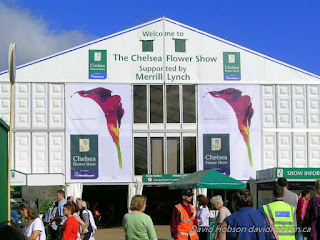
This year was my third visit to the amazing Chelsea Flower Show in London, England. Always an exciting adventure, it was just as (fill in your favourite superlative here) as ever. The interior of the Grand Pavilion appeared crammed with plants from every nursery business in Britain, including a yellow Streptocarpus, produced by Lynne Dibley, owner of Dibleys Nurseries. 

Streptocarpus colours follow a range through pink, blue or purple, but this one is truly unique. It took eleven years and endless hybridizations to produce a yellow variety. Naturally, I had to have one, then and there. I asked Lynne (I think it was Lynne) if they were for sale — NO. Can I buy one anywhere — NO. Will they be available soon in Canada— NO. Will you ship to Canada — NO. I left my disappointment in the Grand Pavilion and went on to view the large show gardens.

As ever, the competition is intense to win a gold medal at Chelsea. The large gardens are sponsored, and it’s no wonder considering they cost hundreds of thousands to create, and stay in perfect condition, for only five days. And I thought I went over board at the garden centre today with three trays of plants. A number of gold medals were awarded, but only one garden in each class receives Best in Show. This year it went to The Laurent-Perrier Garden Designed by Tom Stuart-Smith, a winner of six gold medals at Chelsea. 

Try to hire him for a front-yard makeover now — good luck. His winning design was a dreamy understatement of simple elements — large, zinc water tanks, full to the brim and surrounded by only green and white plants. Around me, I could feel a softening in the energy in the crowd around me as we gazed at an example of perfection in design. Not withstanding my level of awe, I confess, I wanted to run and soak my weary feet in one of the tanks.

The judging of gardens at Chelsea is done by professionals, but there is one award much sought after — The BBC RHS Peoples' Award, chosen by TV viewers and show visitors.  It was awarded this year to Cleve West for The Bupa garden. How do I describe a garden of pathways and colourful plants dominated by a big stone globe? Same as those who voted for it — Wow! Designed partially as a sensory garden, it was one of the few show gardens that would be moved to a permanent location, a nursing centre in Battersea, south-west London.

I did have another favourite, and if you remember the sixties fondly, this one may have been yours. Many will be surprised to learn, that the late Beatle, George Harrison, was a passionate gardener. In fact, he dedicated his 1980 memoir, I Me Mine, to gardeners everywhere. This year at Chelsea, he was commemorated in return with a garden designed by his widow, Olivia Harrison, and landscape designer, Yvonne Innes.

The garden was planned to show the stages of George’s life, beginning with a rough patch of grass reminiscent of his father’s garden plot in Arnold Grove, George’s birthplace. A mosaic path of explosively psychedelic colours wound through the garden, past a glass wall bearing an image of a contemplative George. 

His lyrics, “Floating down the stream of time, from life to life with me” were displayed beside a tranquil pool below. The garden ends at a peacefully serene white pavilion. Imagine.


By late afternoon, tired of the crowds, I decided to explore the streets of Chelsea. I was surprised to discover Tite Street, once the home of playwright, Oscar Wilde. I don’t believe Oscar was much of a gardener, but I’m fond of a quote of his that reflects in a way what Chelsea is all about: “It seems to me that we all look at Nature too much, and live with her too little.”

First published in Waterloo Region Record May 2008

Sissinghurst

As I stared at the old Mountbatten Juniper at the foot of my garden, a few words of poet and novelist, Vita Sackville-West, came to mind. An aristocratic celebrity of the nineteen-thirties with an exuberant lifestyle, Vita, besides being the garden columnist for The Observer newspaper, was the creator of one of Britain’s most famous gardens located at Sissinghurst castle in Kent. Thanks to a spur of the minute decision to fill some spare time while in London, I was fortunate enough to visit the garden this past spring.


Travelling to Sissinghurst is something of a pilgrimage for gardeners, and although it took a hastily coordinated subway, train, and country cab ride to reach the property, which is located in the heart of Kent, I’m so happy that I made the trip.

The castle at Sissinghurst is, in reality, a large Elizabethan mansion, almost derelict when Vita and her husband, Harold Nicholson, bought the place in 1930. Eight years later, the mansion was restored and the impressive gardens they designed and created were opened to the public for the first time. In 1967, it was taken over by The National Trust and is visited each year by both gardeners and lovers of history.


There are actually ten gardens, separated by hedges, arches, and moss covered walls draped with climbing roses. Each one is unique and secluded, but all share the peace and tranquility of the gentle countryside that surrounds the property. They are a joy to explore. Turn a corner and there’s gorgeous white wisteria in full bloom dominating a red brick wall. It only blooms for a couple of weeks in late May and for once I was so lucky to be in the right place at the perfect time to see it.


Pass through an archway and you’re in a walled garden with every imaginable perennial bordering a soft green lawn. In the rose garden, I discovered shrub roses with their canes cleverly turned down into the soil. The tips had been encouraged to take root, resulting in profusely blooming hoops. There’s a nuttery, a lime walk, a moat and a herb garden. So much to see and absorb, but there was more. I was able to climb the 78 spiral stone steps of the restored tower that dominates the garden and view the beauty from an entirely different perspective.


Being there on a sunny afternoon in springtime, the garden in full bloom, water flowing softly, and songbirds warbling away, it wasn’t an easy place to leave, but I hope to return some day, perhaps next spring.


Meanwhile, the spirit of Vita lives on in her words that describe the bond between those who visit her masterpiece: "These mild gentlemen and women who invade one's garden after putting their silver token into the bowl . . . are some of the people I most gladly welcome and salute. Between them and myself a particular form of courtesy survives, a gardener's courtesy, in a world where courtesy is giving place to rougher things."


I will never have a garden anywhere near as grand as the one at Sissinghurst, but already, what I learned from Vita Sackville-West is beginning to influence the way I think about at my own modest garden. I like to think I share something with that remarkable, visionary woman. As I stood there at the foot of my garden, saw in hand. I could hear her words. She said: "The true gardener must be brutal . . . and imaginative for the future." The scraggly old juniper simply had to go.


First published Waterloo Region Record September 2007